Car Stalls When Coming to a Stop? What the Pattern Can Tell You
Car Stalls When Coming to a Stop — The Pattern Matters More Than the Guess
"My car stalls when I come to a stop" sounds like one problem. It isn't — and treating it as one is how people end up replacing parts that were never the fault. An engine can die while the car is still rolling, die as it slows, die only once it is fully stopped, or idle perfectly in Park and die the moment Drive is selected. Those are different events, they point in different directions, and the safe next step for one is not the safe next step for another.
So this page does not open with a list of causes. It opens with two questions — when did the engine die, and what happened when you tried to restart it — because the pattern you can observe from the driver's seat is worth more than any guess at a part. Where a manufacturer has documented one of these patterns on a specific vehicle, this page shows you that documentation, with its scope attached. Where no documentation exists, this page says so and turns your observation into something a shop can actually use.
One boundary before anything else: this page owns the stall and its pattern only up to the restart attempt. If the engine cranks but won't restart, or won't crank at all, that encounter belongs to a different page — our car won't start guide owns the crank and no-start side, including what a jump-start does and does not prove. Come back here for the pattern that led up to it.
First, the safety gate: did the engine stall while the car was still moving?
This question comes before every branch below, because a stall in motion is a different emergency from a stall at a standstill.
If the engine died while the car was still moving, the procedure documented in owner's manuals is a stop procedure, not a driving procedure. Hyundai's manual states it in one sequence: "Reduce your speed gradually, keeping a straight line. Move cautiously off the road to a safe place. Turn on your hazard warning flasher. Try to start the engine again. If your vehicle will not start, contact an authorized HYUNDAI dealer or seek other qualified assistance." A Lexus owner's manual (for the ES 250) documents the same shape in its emergency section — slow gradually, keep a straight line, move off the road, flashers on, then try a restart.
Three things about that moment are worth knowing before you are in it, each in the manufacturer's own words:
- Steering and braking get much heavier with the engine off. Hyundai warns of "loss of power assist for the steering and brake systems," adding that you "can still stop your vehicle by applying greater force to the brake pedal than typical" and that "the stopping distance, however, will be longer than with power brakes." The ES 250's Lexus manual puts it this way: "If the engine is not running, the power assist for the brakes and steering will not work so steering and braking will be much harder than usual." GM's manuals warn that turning the vehicle off while moving "may cause loss of power assist in the brake and steering systems." The wording differs because the systems differ — and these particular manuals span different years and different brake and steering systems — but each one is telling its driver the same observation: expect the wheel and the pedal to feel much heavier, so slow gradually and use one firm, steady application of the brakes rather than pumping the pedal.
- The brake pedal has a limited reserve, so don't waste it. The ES 300's Lexus manual explains that with the engine off there is "enough reserve vacuum for one or two stops but no more," and cautions: "Do not pump the brake pedal if the engine stalls. Each push on the pedal uses up your vacuum reserve." Hyundai's instruction is the same in its own words: "Do not pump the brake pedal when the power assist has been interrupted." One firm, steady application is what these manuals ask for.
- If you attempt a restart while still rolling, the manuals name Neutral — never Park. Hyundai: "If the engine stalls while you are in motion, do not attempt to move the shift lever to the P (Park) position. If traffic and road conditions permit, you may put the shift lever in the N (Neutral) position while the vehicle is still moving and press the Engine Start/Stop button in an attempt to restart the engine." Note the condition Hyundai attaches — if traffic and road conditions permit. GM states the same rule for its vehicles: "To restart the engine when the vehicle is already moving, use N (Neutral) only." Honda's manual gives Neutral the same job: "Use Neutral if you need to restart a stalled engine."
If the car stalls in a crossroad or crossing, Hyundai's manual adds one more step: if it is safe to do so, move the shift lever to Neutral "and then push the vehicle to a safe location."
And if it will not restart where you stopped? The manuals end the sequence there — Hyundai's instruction is to contact a dealer or "seek other qualified assistance," which in practice means a tow. What no manual on this page offers is permission to keep driving a car that has stalled in motion and hope it behaves. One more trigger from that ES 300 manual, worth taping to this gate: "If the engine becomes difficult to start or stalls frequently, have the engine checked immediately." A stall that repeats has already given you its answer.
If your complaint is that the steering itself is heavy with the engine running — not just heavy in the moment the engine died — that is a different symptom with its own page: our steering wheel hard to turn guide. And if the engine kept running but the car stopped pulling, the engine did not stall at all — that event belongs to our car won't shift into gear guide.
One check first: was that the automatic stop-start system doing its job?
Many current cars shut the engine off at a full stop on purpose, and restart it the moment you release the brake. Before classifying anything below, confirm your engine-off moment was not that system working as designed — because the manufacturers document exactly what "working as designed" looks like:
- Hyundai documents an Auto Stop indicator that lights green when its Idle Stop and Go system stops the engine at a standstill, with the engine restarting when you release the brake pedal. Its warning state is different: if the Auto Stop indicator lights yellow, Hyundai calls that a system malfunction and directs you to a dealer.
- Kia documents the same observable in its own wording: a green AUTO STOP indicator while the system holds the engine off, restart when the brake pedal is released — and a continuously blinking amber indicator means contacting an authorized Kia dealer.
- Jeep documents its Stop/Start system shutting the engine down at a stop with the tachometer at zero and the Stop/Start telltale lit, restarting when the brake pedal is released or the accelerator pressed — and a "Service Stop/Start System" message as the malfunction signal.
- Honda documents its Auto Idle Stop turning the engine off when the vehicle stops in Drive with the brake pressed, the idle stop indicator appearing, and the engine restarting when you release the brake pedal, turn the steering wheel, or press the accelerator.
Colors and indicator names are each manufacturer's own — your owner's manual is the reference for your car. The observation that matters is the one none of these manuals describe as normal: the engine died without the system's stop indicator showing, or it did not restart when you released the brake. That moment is outside documented stop-start behavior, and it belongs in the router below.
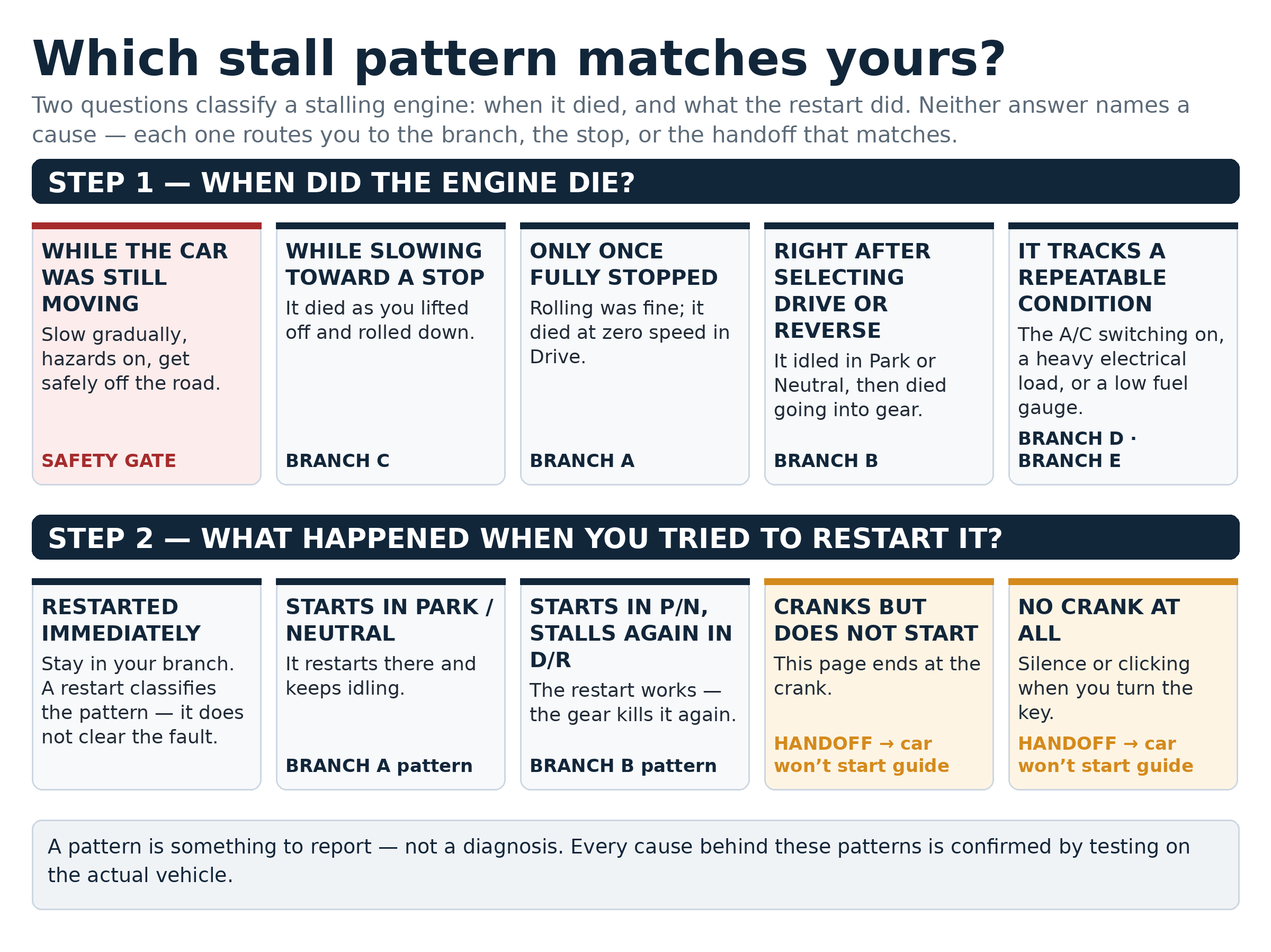
Start here: two questions
Question 1 — When did it stall?
- While the car was still moving → go back to the safety gate above. That classification outranks everything below.
- While slowing toward a stop — it died as you lifted off and rolled down → Branch C.
- Only once fully stopped — rolling was fine; it died at zero speed in Drive → Branch A.
- Immediately after selecting Drive or Reverse — it idled in Park/Neutral, then died going into gear → Branch B.
- It tracks a repeatable condition — the air conditioning switching on, a heavy electrical load, or a low fuel gauge → Branch D (load) or Branch E (fuel level).
Question 2 — What happened when you tried to restart it?
- Restarted immediately → stay in your Question 1 branch. A fast restart classifies the pattern; it does not clear the fault (see "What the restart behavior tells you" below).
- Starts and idles in Park/Neutral → Branch A territory.
- Starts in Park/Neutral but stalls again the moment you select Drive or Reverse → Branch B.
- Cranks but does not start → this page ends here. That encounter is owned by our car won't start guide.
- No crank at all → same handoff. If a battery or charging warning light came on before the stall, start with our battery light while driving guide — a stall preceded by that warning is the charging side of the story.
Nothing in either question leads to a diagnosis. Each answer leads to one of four outcomes: something to observe, a reason to stop, professional service, or a handoff to the page that owns the next problem.
Branch A — It dies only once fully stopped, and restarts
The car rolls to the stop without complaint. At zero speed, in Drive, the engine dies. You shift to Park or Neutral, it restarts, and it idles. Roll back into Drive and it may hold — or the whole thing repeats at the next light.
This pattern is real enough that a manufacturer has written it down for specific vehicles, and this page will show you that documentation exactly as far as it goes — no further. In an information bulletin titled "Information on Stalling When Shifted into Drive or Reverse," GM documented this pattern on the 2024–2025 Chevrolet Silverado 1500 and GMC Sierra 1500 with the 3.0L Duramax (LZ0) diesel and MQB/MQC transmissions: "the engine stalls at 0 mph (0 km) when coming to or at a stop. The engine will restart when the transmission is shifted to park or neutral but will immediately stall again when shifted into drive or reverse." GM also notes the warning light may never come on — "Some customers may also comment that the MIL is not illuminated."
What caused it on those trucks, in GM's own cautious wording? "This condition may be caused by the Torque Converter Clutch (TCC) may be stuck on." Read that sentence the way GM wrote it: a possible cause, on those trucks, in a bulletin addressed to technicians. It is not a verdict on your vehicle, and this page will not turn it into one — a stalled-at-zero-speed pattern on any other car, or even on one of these trucks, still has to be confirmed by a professional with the vehicle in front of them.
What this branch asks of you:
- Confirm it wasn't the stop-start system (the check above). No indicator, or no restart on brake release, means unintended stall.
- Log the pattern, not a guess. Every stop or one in five? Engine warm or cold? Does it restart instantly, every time? Two or three honest lines are what a shop works from.
- Have it professionally evaluated. The defining feature of this complaint is that it repeats. The ES 300's Lexus manual states the endpoint plainly: "If the engine becomes difficult to start or stalls frequently, have the engine checked immediately."
What to tell your mechanic (copy-paste)
It dies only once I'm fully stopped in Drive. It restarts in Park or Neutral and idles. [If yours is a 2024–2025 Silverado 1500 or Sierra 1500 with the 3.0L Duramax: GM has an information bulletin, 24-NA-230, describing this exact pattern on my truck — can you check whether it applies?]
Branch B — It idles in Park or Neutral, then dies when you select Drive or Reverse
This is the mirror image of a car that won't idle at all: yours idles. The failure arrives precisely at the moment you ask it to take a gear.
The same GM bulletin documented for Branch A is the proof that this pattern exists as a documented condition and not just a forum anecdote — on those 2024–2025 Silverado 1500 and Sierra 1500 diesels, the engine "will restart when the transmission is shifted to park or neutral but will immediately stall again when shifted into drive or reverse," a behavior GM ties, in its own hedged wording, to a torque converter clutch that "may be stuck on." That sentence covers those trucks. For every other vehicle, the honest statement is narrower: this pattern is a strong, specific observation — and it is not, by itself, a diagnosis. The same behavior can have different causes in different vehicles, and confirming any of them is workshop work, not driver's-seat work.
Two boundary notes keep this branch clean:
- Don't keep cycling Drive and Reverse to re-test it. The first clean observation — idles in Park/Neutral, dies into gear, repeatably — already contains everything a shop needs. Repeating the cycle adds wear to the encounter and nothing to the information.
- If the engine keeps running but the car won't move, your engine never stalled; you have an engagement problem, and it belongs to our car won't shift into gear guide. The line between the pages is whether the engine died.
The endpoint here is professional evaluation, with the observation doing the talking.
What to tell your mechanic (copy-paste)
It starts and idles in Park and Neutral. The moment I shift into Drive or Reverse, it stalls. It does this every time.
Branch C — It dies while slowing down or lifting off the throttle
Your stall doesn't wait for the stop. As you lift off the accelerator and the car rolls down toward the light, the engine simply goes quiet — and by the time you've stopped, you're sitting in a dead car that may restart when you turn the key, or may not (if it doesn't, Question 2 above routes you out of this branch).
This branch is observation only, and this page is going to be straight with you about why: no manufacturer document we could stand behind ties this pattern to a cause a driver could confirm. So this page will not name one. What it will do is sharpen the observation, because for this pattern the observation is the deliverable:
- When exactly? As you lift off, mid-way through the slowdown, or in the last few feet before zero?
- Every time, or only sometimes? Note what was different — cold engine, long downhill, turning into a side street.
- What did the restart do? Instant and uneventful, or did it change the story (if it changed the story, Question 2 above routes you)?
That this pattern can be a genuine, documentable fault — and not something a warning light will always announce — is proven by a manufacturer document, scoped to its own vehicles. In its safety recall report for the 2017 Chrysler Pacifica with the 3.6L engine, FCA described vehicles that "may experience an engine stall without prior warning, without lighting a Malfunction Indicator Lamp and without setting any Diagnostic Trouble Code," adding that "in the majority of cases the stalling occurs at low speed, while decelerating, while at idle or while negotiating a turn." One model, one engine, one recall — but it establishes two things a driver should hear: a slowing-down stall can be a real defect, and the absence of a warning light proves nothing either way.
Endpoint: the pattern, logged, goes to a professional. A shop confirms the cause with testing; this page's job was to make sure you arrive describing the event precisely instead of apologizing for it.
What to tell your mechanic (copy-paste)
It stalls while I'm slowing down, before I reach a full stop. It happens [every time / only sometimes — note when]. It restarts [immediately / normally] afterward. No warning light [comes on / — note if one did].
Branch D — It seems to track a load: the A/C, the defroster, electrical demand
This branch comes with its label printed on it: inference, not evidence. Treat it that way and it is useful; treat it as more and it will mislead you.
The observation goes like this: the engine dies at stops when the air conditioning is running, and behaves with it off. Or it died the moment a heavy electrical load joined in. That timing correlation is worth writing down — it genuinely patterns what you tell a shop, and a technician will ask. But a correlation in time is not a cause. Two things happening together tells you they happened together; confirming that one produced the other requires testing this page does not do and will not simulate. No manufacturer document behind this page ties a load-coincident stall to a specific component a driver could name, so this page names none.
What to record: which load, on or off, every time or once, engine warm or cold, and whether the restart behaved normally (if it didn't, Question 2 routes you out of this branch entirely). Then professional evaluation, with the log in hand.
What to tell your mechanic (copy-paste)
It stalls at stops when [the A/C is on / the rear defroster and blower are running]. With that load off, [it idles normally / I haven't tested it that way]. It restarts normally.
Branch E — It seems to track the fuel gauge
This branch has two halves, and the line between them is the whole point.
E1 — One documented case where fuel level is genuinely part of the story: a Ford recall
For exactly one vehicle population, a manufacturer has officially connected stalling to fuel level. Under NHTSA recall 18V-735 (Ford's number 18S32), Ford recalled certain 2012–2018 Ford Focus vehicles with a 2.0L GDI or 2.0L GTDI engine — over 1.28 million of them — because "the Canister Purge Valve (CPV) may malfunction, possibly causing excessive vacuum in fuel vapor management system," which "may result in an engine stall while driving, without warning and without the ability to restart the vehicle."
Ford's interim instruction to those owners, quoted exactly, was: "Until the vehicle is serviced for this concern, owners are advised to keep the fuel tank at least halfway full."
Read that instruction inside its fence. It is a recall-specific, interim instruction for owners of those Focuses awaiting service — not a diagnostic test, not evidence about your car unless your car is in that population, and not a general rule for any vehicle that stalls. Ford framed the risk as a stall while driving, and this page won't relocate it to a stop sign on Ford's behalf. The recall also is not ancient history: in 2026, NHTSA records show 255,404 of those same Focus cars recalled again (campaign 26V369) because the original repair had been applied incorrectly — which is why "mine was already fixed once" is not the end of a VIN check.
If you own a 2012–2018 Focus with the 2.0L engine: check your VIN at nhtsa.gov/recalls. If it's in the population and hasn't been serviced for this recall, the halfway-full instruction is Ford's, addressed to you, until it is.
E2 — Every other car: the gauge correlation is a log entry, nothing more
If your car stalls when the tank runs low, or on slopes, and behaves when full — write it down, with the gauge reading and the circumstances. That correlation is legitimately useful information to hand a shop. It is also where this page stops: no document behind this page supports turning a low-tank pattern into a fuel-system diagnosis for a vehicle in general, and the Focus instruction in E1 does not transfer to your car no matter how similar the story sounds. There is no half-tank rule here. There is a log entry, and a professional evaluation to receive it.
What to tell your mechanic (copy-paste)
It stalls when the fuel gauge is around [reading], and [does / doesn't] do it with a full tank. It restarts [normally / with difficulty] afterward.
What the restart behavior tells you
The second question in the router deserves its own page-level treatment, because drivers routinely read too much — and too little — into a restart.
It restarted immediately. Good — and read narrowly. An instant restart tells you which branch you're standing in; it is not proof the fault is minor, and it is not proof the car is safe to keep using as-is. Every branch above describes a complaint whose defining feature is repetition: a car that stalled once at a stop and restarted has shown you a pattern, not an all-clear. The restart classifies; it does not acquit.
It needed Neutral while you were still rolling. The manuals that allow a restart attempt in motion name Neutral, and only Neutral — Hyundai permits the attempt "if traffic and road conditions permit" and forbids forcing Park while moving; Honda's instruction is "Use Neutral if you need to restart a stalled engine"; GM's is "use N (Neutral) only" when the vehicle is already moving. That agreement is why this page can state the observation confidently, but notice what each manual is actually giving you: a position for one restart attempt while you get stopped — not a technique for driving on. Once you're stopped, the starting rules are the ordinary ones (Hyundai: "The engine starts only when the shift lever is in N (Neutral) or P (Park)"; Honda: "It must be in Park or Neutral to start the engine," with Honda's current manuals adding that "it is safer to start it in P").
It cranks but won't restart. This page's intent ends at that crank. The encounter from here — what cranking normally-but-never-firing means, what a jump-start proves, when to stop cranking — is owned in full by our car won't start guide, including the specific terminal for a car that died while driving and now won't restart. Go there; don't keep cranking here.
No crank at all. Same handoff, same page — silence and clicking are its opening questions. The one distinction worth making before you go: if a battery/charging warning light showed up before the stall, that sequence is the charging system's story, and our battery light while driving guide owns it, including what happens when a car is switched off after that warning and refuses to restart.
One companion symptom reroutes everything above: if the check engine light was flashing as the engine died, the stall arrived with a misfire emergency in progress, and our check engine light flashing guide owns that decision. Leave this page and take that one.
Before the tow truck: three closing steps
- Write the symptom log. When it dies (moving, slowing, stopped, into gear), how often, what the restart did, whether any warning light appeared and which one, and what else was running at the time. Two precise sentences now are worth twenty vague ones at the service counter.
- Check your VIN at nhtsa.gov/recalls. The Focus recall in Branch E is the standing example of why: a stalling complaint can be documented recall territory, and a free VIN check settles whether yours is. A previous repair doesn't close the question — the 2026 re-recall exists precisely because some first repairs were wrong.
- Get the professional diagnosis. Every branch on this page ends there, because every cause behind these patterns is confirmed by testing on the actual vehicle — and no cause was ever going to be confirmed from the driver's seat. This page routed you by what you could observe and ruled out the guesses it couldn't support. That is as far as observation honestly goes, and it's further than a parts cannon gets you.
FAQ
Why does my car stall when I stop?
Because "when you stop" is actually several different moments — still rolling, slowing down, fully stopped, or the instant you select a gear — and they don't share one answer. That's why this page routes by the pattern first. For specific vehicles the pattern is even documented: GM has written down a stall-at-zero-speed pattern for certain 2024–2025 Silverado and Sierra diesels, and Ford recalled over a million 2012–2018 Focuses for a stall risk tied to a malfunctioning canister purge valve. For every other car, the pattern you've observed is what a professional uses to find the cause — this page deliberately doesn't guess one for you.
Why does it start in Neutral but stall in Drive?
Because idling unloaded and holding against a gear are different demands, and your car is meeting one and failing the other. The pattern is documented on specific vehicles — GM's bulletin for 2024–2025 Silverado 1500 and Sierra 1500 3.0L diesels describes engines that restart in Park or Neutral and stall again in Drive or Reverse, and GM names a torque converter clutch that "may be stuck on" as a possible cause on those trucks. On anything else, the behavior is a precise observation to hand a shop — it is not, on its own, a diagnosis.
Can a car restart after stalling while moving?
The owner's manuals that address it say a restart attempt in motion is made in Neutral — Hyundai allows it "if traffic and road conditions permit" and warns never to move the selector to Park while moving; Honda instructs, "Use Neutral if you need to restart a stalled engine"; GM states "use N (Neutral) only" when the vehicle is already moving. It's one attempt on the way to getting stopped, with steering and brakes suddenly heavy — not a way to keep driving. If it doesn't restart, the manuals' sequence ends at a safe stop and qualified help.
Why does it stall only when slowing down?
This page won't pretend to know — no manufacturer document behind it assigns that pattern a cause a driver could confirm, and inventing one would be worse than useless. What the pattern deserves is precision: when in the slowdown, every time or only sometimes, and how the restart behaved. It can be a genuine documented fault: FCA's recall of the 2017 Pacifica 3.6L describes stalls "at low speed, while decelerating, while at idle or while negotiating a turn," with no warning light and no stored code. Log it that carefully and hand it to a professional.
Does stalling with the A/C on prove the A/C caused it?
No. It proves the stall and the load coincided. Timing correlation patterns what you report to a shop — it is worth recording exactly which load was on — but confirming that the load produced the stall is testing, not observation, and this page names no component for it.
Does fuel level matter?
In exactly one documented place: Ford's recall of certain 2012–2018 Focus 2.0L cars advised owners, until the vehicle was serviced, to "keep the fuel tank at least halfway full." That is a recall-specific interim instruction for that population — not a test, and not a rule for other cars. For any other vehicle, a stall that tracks the fuel gauge is a useful log entry for a shop, full stop.
What if it cranks but won't restart?
Then you've left this page's territory. A car that cranks normally but never fires — including one that died while driving and now won't restart — is the opening question of our car won't start guide, which owns that encounter in full. This page owns the stall and its pattern up to the restart attempt; everything after the crank is theirs.
Sources
Every procedure, quotation, and safety claim in this draft traces to an official manufacturer or government source opened during Deep Validation:
- Hyundai Elantra 2024 Owner's Manual (Ch. 6 and Ch. 8) — stall-while-driving procedure, restart-in-Neutral while moving, starter interlock, loss of power assist, brake-pedal guidance. ownersmanual.hyundai.com
- Hyundai Palisade 2024 Owner's Manual — Idle Stop and Go indicator behavior (green/yellow) and restart conditions. ownersmanual.hyundai.com
- Kia Seltos 2024 Vehicle Feature Tips — ISG AUTO STOP indicator behavior (green/blinking amber). sweb.owners.kia.us
- Jeep Grand Cherokee 2023 Owner's Manual — Stop/Start (ESS) operation, restart behavior, "Service Stop/Start System" malfunction message. vehicleinfo.mopar.com
- Honda Pilot 2018 Auto Idle Stop owner information — idle-stop indicator and restart behavior. owners.honda.com
- Lexus Owner's Manual OM32464U (ES 250, 1990–1991) — stall-while-driving procedure, loss of power assist. assets.sia.toyota.com
- Lexus Owner's Manual OM33406U (ES 300, 1992–1993) — brake-booster reserve, restart in Neutral, frequent-stall inspection instruction. assets.sia.toyota.com
- Honda Owner's Manual (AC0101) and 2022 Civic Sedan Owner's Manual — "It must be in Park or Neutral to start the engine," "Use Neutral if you need to restart a stalled engine," safer to start in Park. techinfo.honda.com
- Chevrolet Silverado 4500/5500/6500HD 2024 Owner's Manual and 2025 Silverado/Sierra 1500 Essential Operating and Safety Information — loss of power assist warning; "To restart the engine when the vehicle is already moving, use N (Neutral) only." contentdelivery.ext.gm.com
- GM Service Bulletin 24-NA-230, "Information on Stalling When Shifted into Drive or Reverse" (October 2024) — 2024–2025 Silverado 1500 / Sierra 1500, 3.0L LZ0, MQB/MQC; stall at 0 mph; restart in Park/Neutral, stall in Drive/Reverse; TCC "may be stuck on." (https://static.nhtsa.gov/odi/tsbs/2024/MC-11010906-0001.pdf)
- NHTSA recall 18V-735 (Ford 18S32), acknowledgment letter RCAK-18V735-8283.pdf — 2012–2018 Ford Focus 2.0L GDI/GTDI; canister purge valve; "keep the fuel tank at least halfway full." static.nhtsa.gov
- NHTSA recall 26V369 (Ford 26S40), acknowledgment letter RCAK-26V369-4216.pdf — 255,404 previously-incorrectly-repaired 2012–2018 Focus vehicles re-recalled (2026). static.nhtsa.gov
- FCA Part 573 Safety Recall Report 18V049 (U01) — 2017 Chrysler Pacifica 3.6L stall "at low speed, while decelerating, while at idle or while negotiating a turn," without MIL or DTC. static.nhtsa.gov