Exhaust Smell Inside Your Car: The Stop-or-Drive Answer Is in Your Owner's Manual
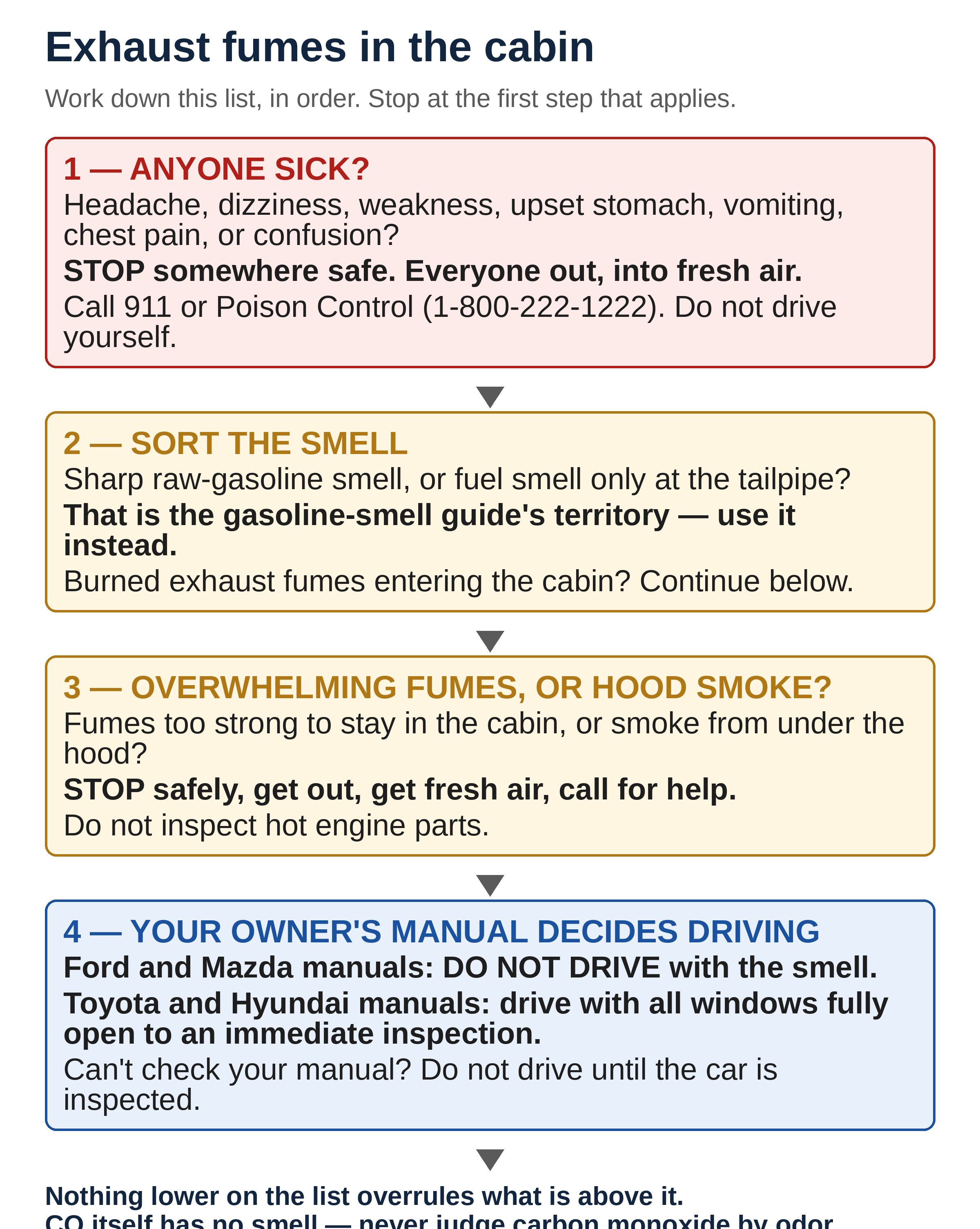
You can smell burned exhaust fumes inside the cabin. The decision comes in a fixed order: check the people first, sort the smell second, and then let your own owner's manual — not a general rule — make the drive-or-don't-drive call. Manufacturers genuinely disagree on this one, and any page that hides that disagreement to give you a simpler answer is not being straight with you.
First: is anyone sick?
If anyone in the car has a headache, dizziness, weakness, upset stomach, vomiting, chest pain, or confusion, stop the car somewhere safe, get everyone out into fresh air, and call 911 or Poison Control at 1-800-222-1222 right away. Those are the CDC's listed symptoms of carbon monoxide (CO) poisoning, and the CDC's instruction for suspected poisoning is to move to outside air and make that call. Do not drive yourself to get help: CDC/NIOSH guidance for CO exposure says, "Do NOT drive a motor vehicle–get someone else to drive you to a health care facility." (That line was written for workers; no federal agency publishes a separate protocol for a leaking car, and this general CO guidance is the right one to use.)
This gate outranks everything below, including your owner's manual. It also works with no smell at all: CO is, in the CDC's words, "an odorless, colorless gas that can cause sudden illness and death if inhaled." Symptoms alone are reason enough to act. Feeling fine, on the other hand, is not a clearance — read the CO section before you decide anything.
Second: is it actually exhaust?
Two different smells get called "gas fumes," and they are different emergencies:
- The sharp smell of raw gasoline — like fuel at the pump. That is unburned fuel, and it follows fuel-leak and fire logic, not this page. Use our guide to a car that smells like gas. If raw fuel is even a possibility, that page's rule governs — use it.
- A fuel smell only at the tailpipe, noticed outside the car, is also that guide's branch — unburned fuel leaving with the exhaust.
- Burned exhaust fumes coming into the cabin — engine fumes, not raw fuel — is this page. Stay here.
Third: are the fumes overwhelming?
If the fumes are so strong that the cabin is hard to stay in, treat it like the sickness gate: stop safely, get out, fresh air, call for help. If you see smoke coming from under the hood, stop — and do not go inspecting hot engine parts; that is a job for a tow truck and a shop. (A cloud of white, steam-like vapor at the tailpipe is a different sign entirely, covered by our coolant leak guide.)
The drive decision: your manual answers it — and manuals disagree
There is no honest universal rule here, because manufacturers print opposite instructions.
Ford (owner's-manual warning in current U.S. manuals): "WARNING: Exhaust leaks may result in entry of harmful and potentially lethal fumes into the passenger compartment. If you smell exhaust fumes inside your vehicle, have your vehicle inspected immediately. Do not drive if you smell exhaust fumes."
Mazda: "Do not drive your vehicle if you smell exhaust gas inside the vehicle… If you smell exhaust gas inside the vehicle, keep all windows fully open and contact an Authorized Mazda Dealer immediately." Read Mazda's open windows carefully: they are paired with do not drive — ventilate while you are stopped and call a dealer. Mazda is not giving you permission to drive that way.
Toyota (current manuals, in a section headed "Important points while driving"): "If you smell exhaust gases in the vehicle even when the back door is closed, open the windows and have the vehicle inspected at your Toyota dealer as soon as possible."
Hyundai (current manuals): "Carbon monoxide is present with other exhaust fumes. If you smell exhaust fumes in your vehicle, drive with all the windows fully open. Have your vehicle inspected and repaired immediately."
So Ford and Mazda forbid driving with the smell. Toyota and Hyundai instruct you to drive — windows fully open — directly to an inspection. Your own car's manual is the instruction that controls, and it is worth the two minutes to find it (glovebox or the manufacturer's app). All four agree on the facts underneath: the gas is dangerous and the car needs immediate inspection either way — and the CO in it, the CDC notes, is colorless and odorless.
If you can't check your manual right now
Use the conservative default, stated together with its exception: do not drive the car until it has been inspected — unless your own owner's manual expressly tells you to drive with the windows fully open, in which case follow your manual exactly: windows fully open, inspection immediately, no detours. This default is Spectpoint's safety position for when a manual can't be checked; it is not a manufacturer consensus, and where your manual does give a windows-open instruction, your manual wins. If the car cannot be moved in line with your manual's instruction — or you feel unwell at any point — the answer is a tow, not a drive.
Why your nose can't settle the CO question
What you smell is exhaust gas. CO itself has no smell at all — the CDC and every manual quoted above say so. Three things follow:
- The smell tells you exhaust gas is getting into the cabin. It does not tell you how much CO is in that gas.
- "It stopped smelling" is not evidence that anything stopped. CO would give you no smell either way. Never use your nose as the instrument, in either direction.
- No number fixes this. Some websites quote a parts-per-million figure as the line between safe and unsafe driving. The figure usually traces back to the EPA's outdoor air-quality standard, averaged over hours — a city-air compliance number, not a consumer decision threshold. No health authority publishes a ppm value for "safe to keep driving," and we won't invent one.
Advice online that no authority backs
Some sites turn an active exhaust leak into a routine: set the HVAC to recirculation, crack the windows at speed, install a household CO alarm in the cabin, and "take these precautions every time you drive" until you get around to the repair. No manufacturer manual and no health agency supports driving this way. A recirculation setting does not repair a leak path. Open windows are not a guarantee — two of the four manufacturers above forbid the drive entirely. And a household CO alarm is designed for homes; it is not a device that can clear a car for driving. Those same pages usually bury one correct sentence — if you feel unwell, stop, get fresh air, and seek medical attention. That sentence is the whole protocol. Everything around it is decoration on a leak that needs a shop.
2011–2017 Ford Explorer owners: read this in the right order
Start with your manual, not the investigation. Ford's instruction for your vehicle is the warning quoted above — "Do not drive if you smell exhaust fumes" — and Ford still prints it in current manuals. Nothing in this section changes that instruction for your car.
The investigation, separately. NHTSA's EA17-002 examined exhaust-odor complaints in 2011–2017 Ford Explorers, including Police Interceptors — about 1.33 million vehicles — and the agency reviewed over 6,500 consumer complaints. A complaint count is an allegation count, not a risk measurement. NHTSA's closing report found that the Explorers it tested, "when accurately tested and measured produce occupant compartment CO levels which fall below currently accepted health standards," and that the highest levels it measured came from sealing failures: holes drilled into police vehicles for upfitting equipment, and rear-crash-damage repairs that had not restored sealing. Ford ran free repair programs covering exactly those sealing paths at the time; they were Ford programs rather than recalls, and they ended years ago. NHTSA closed the investigation in January 2023, concluding it "has not identified a safety related defect that represents an unreasonable risk to motor vehicle safety" — while stating in the same report that "the closing of this investigation does not constitute a finding by NHTSA that no safety-related defect exists."
What that means for your Explorer is narrow: the fleet was measured, and the measured fleet sat below health standards. It is not a measurement of your vehicle, and it is not permission to set aside Ford's manual. If your Explorer smells of exhaust in the cabin, Ford's manual instruction applies, and tell the inspector about any rear body repairs or equipment that was installed in the vehicle — those were the investigation's documented entry paths.
What the inspector will check — and what to tell them
An exhaust smell in the cabin is a reason for inspection, not a diagnosis you can make from the driver's seat. A professional will typically check:
- the exhaust system itself for leaks — your manual's first suspect;
- body sealing at the rear of the cabin — seals, plugs, and hatch/liftgate sealing;
- whether anything was installed in or repaired at the rear of the vehicle.
And the observations that genuinely help them, which cost you nothing and involve touching nothing hot:
- when the smell shows up — idling, driving, or both;
- whether it changes with the fan, vent, or recirculation setting;
- any recent exhaust work, rear body work, or installed equipment.
Report these; don't conclude from them. The timing or fan pattern is evidence for the inspector, not a cause you can name yourself.
FAQ
I smell exhaust in the cabin but I feel fine. Can I drive?
Feeling fine doesn't clear CO — it is odorless, and you can't judge exposure by symptoms. Your manual gives your car's instruction: Ford's and Mazda's manuals say do not drive; Toyota's and Hyundai's say drive with all windows fully open to an immediate inspection. If you can't check your manual, the conservative answer is: don't drive it until it's inspected.
There's no smell at all. Could CO still be a problem?
CO has no smell, so your nose can't rule it in or out. The detectable warning sign is the one this page is built on — exhaust odor entering the cabin. If you ever develop the CDC symptoms without a clear explanation, treat that as its own emergency regardless of smell: fresh air, then 911 or Poison Control.
Opening the windows makes it safe, right?
No. Two manufacturers instruct fully open windows as the way to reach an inspection immediately; two forbid driving with the smell at all. No manual presents open windows as making the car safe — and windows are never a substitute for the inspection every one of them demands.
Should I put a CO detector in the car to decide?
No. Household CO alarms are built for homes and are not a driving-clearance test; no authority endorses using one to decide whether a car with an exhaust leak is safe to drive. The decision comes from your owner's manual and an inspection.
My Explorer was part of that investigation. Am I cleared?
No individual car was cleared. NHTSA measured the fleet below health standards and closed the investigation while stating that closing it is not a finding that no safety-related defect exists. Ford's manual instruction for your car still applies: do not drive if you smell exhaust fumes.
Sources
Every safety instruction, quotation, and investigation claim in this article traces to an official manufacturer or government source opened and re-verified during validation:
- CDC — Carbon Monoxide Poisoning Basics — Symptom set (headache, dizziness, weakness, upset stomach, vomiting, chest pain, confusion) and "Carbon monoxide (CO) is an odorless, colorless gas that can cause sudden illness and death if inhaled." cdc.gov (https://www.cdc.gov/co/faqs.htm)
- CDC — Carbon Monoxide Poisoning Clinical Guidance — Clinical corroboration of the symptom set and severe presentations. cdc.gov (https://cdc.gov/carbon-monoxide/hcp/clinical-guidance/)
- CDC — CO Key Messages (official publication) — "If CO poisoning is suspected, move to outside air, call 911 or your local Poison Control Center at 1-800-222-1222 or consult a health care professional right away." stacks.cdc.gov (https://stacks.cdc.gov/view/cdc/139594/cdc_139594_DS1.pdf)
- CDC/NIOSH Alert 96-118a — "Do NOT drive a motor vehicle–get someone else to drive you to a health care facility." Worker guidance; no vehicle-specific federal CO protocol exists. cdc.gov/niosh (https://www.cdc.gov/niosh/docs/96-118a/)
- Ford Owner's Manual Warning (Ford OwnerManual service) — "Guarding Against Exhaust Fumes": "Exhaust leaks may result in entry of harmful and potentially lethal fumes into the passenger compartment. If you smell exhaust fumes inside your vehicle, have your vehicle inspected immediately. Do not drive if you smell exhaust fumes." fordservicecontent.com (https://www.fordservicecontent.com/Ford_Content/Catalog/owner_information/2020-Ford-Explorer-Owners-Manual-version-1_om_EN-US_03_2019.pdf)
- 2019 Mazda3 Owner's Manual — Engine Exhaust (Carbon monoxide) — "Do not drive your vehicle if you smell exhaust gas inside the vehicle… keep all windows fully open and contact an Authorized Mazda Dealer immediately." mazdausa.com (https://www.mazdausa.com/static/manuals/2019/mazda3/contents/04040108.html)
- Toyota Owner's Manual (OM0A078U) — Exhaust gas precautions — "Important points while driving": "If you smell exhaust gases in the vehicle even when the back door is closed, open the windows and have the vehicle inspected at your Toyota dealer as soon as possible." assets.sia.toyota.com (https://assets.sia.toyota.com/publications/en/om-s/OM0A078U/pdf/OM0A078U.pdf)
- 2025 Hyundai Elantra Owner's Manual — Engine exhaust (carbon monoxide) precautions — "Carbon monoxide is present with other exhaust fumes. If you smell exhaust fumes in your vehicle, drive with all the windows fully open. Have your vehicle inspected and repaired immediately." sweb-owners.hyundaiusa.com (http://sweb-owners.hyundaiusa.com/content/dam/hyundai/us/myhyundai/manuals/glovebox-manual/2025/elantra/CN7-2025-en_US-Full-WEB-2C.pdf)
- NHTSA ODI Resume — EA 17-002 (opening) — Investigation opened 07/27/2017 (prompted by PE16-008); MY 2011–2017 Ford Explorer including Police Interceptor; population 1,333,000 (estimated). static.nhtsa.gov (https://static.nhtsa.gov/complaints/11010277/11010277-AF0DEE51DCB102CAE05375E8789808C8.pdf)
- NHTSA — EA17-002 Closing Report, Ford Explorer Exhaust Odor — "over 6,500 consumer complaints"; measured occupant-compartment CO "below currently accepted health standards"; highest levels from upfitter sealing issues and rear-crash-damage repairs; "has not identified a safety related defect that represents an unreasonable risk to motor vehicle safety"; "The closing of this investigation does not constitute a finding by NHTSA that no safety-related defect exists." static.nhtsa.gov (https://static.nhtsa.gov/odi/inv/2017/INCLA-EA17002-8587.PDF)
- Reuters / Associated Press — January 2023 closure coverage — Closure timing only (documents released January 2023). All findings in this article are quoted from NHTSA's own closing report above. (https://amp.claimsjournal.com/news/national/2023/01/24/314930.htm)