How this oil light while driving diagnosis works
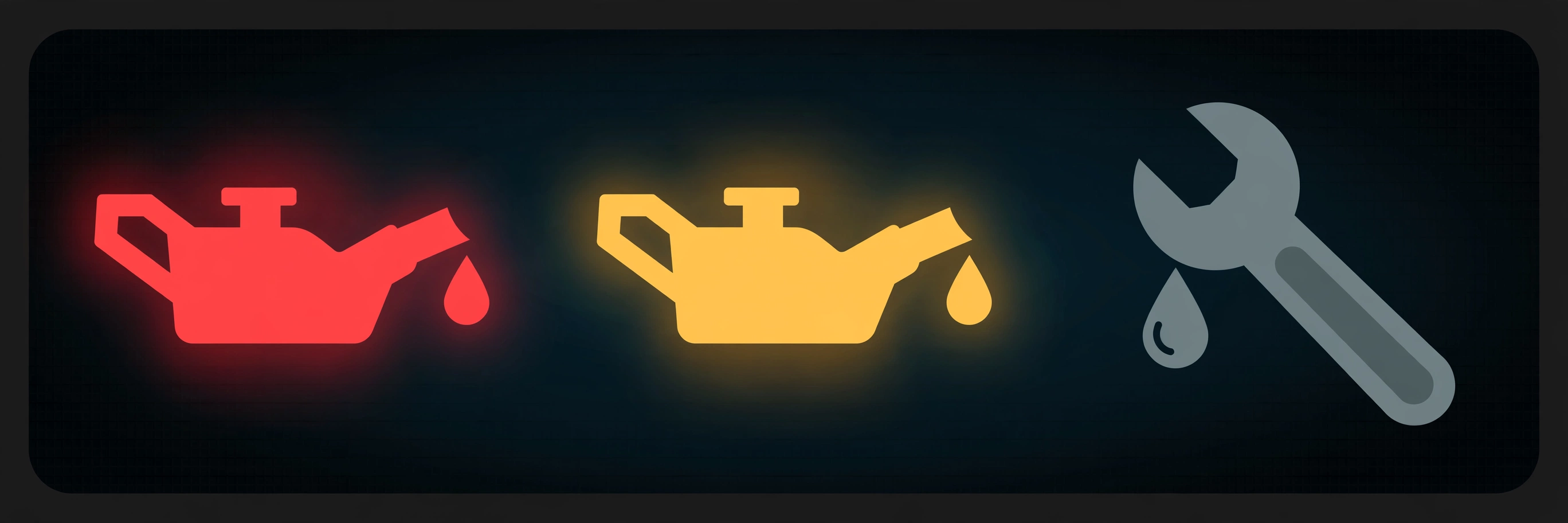
Three different warnings share the oil can. An oil-PRESSURE warning means the lubrication system may have lost pressure — the pump, the pickup, or the oil film the bearings ride on. An oil-LEVEL warning means the sump is running low — serious, but a top-up situation. A maintenance reminder (often a wrench, "oil change due," or a percentage) is a service schedule, not an emergency. The trap: dashboards differ. Volkswagen uses red for pressure and yellow for level; Honda’s manuals describe a single low-oil-pressure indicator that "does not measure the oil level"; some Toyota/Lexus models carry a separate level warning. Never classify by color alone without your manual — VW’s own guide says "for additional information on indicator lights, refer to your vehicle’s Owner’s Manual."
On the urgent question — stop or keep driving — the manufacturers converge. Toyota: pull off the road to a safe place and stop the engine immediately; "do not drive the vehicle with the warning light on—even for one block." Volkswagen: "Do not continue driving!" — and explicitly not even if the oil is at the correct level. Ford: "Stop the vehicle as soon as safely possible, turn off the engine," and "do not resume your journey if it illuminates despite the level being correct." Honda: "Running the engine with low oil pressure can cause serious mechanical damage almost immediately. Turn off the engine as soon as you can safely get the vehicle stopped." Only Honda documents a specific restart check (watch the indicator for 10 seconds after starting — model-specific, not a universal rule). Nobody else gives a universal restart test, so this page doesn’t invent one: if the pressure warning stays on with the engine running, you stop and tow.
This page is a decision tool first and a causes list second. The urgent question — stop, check the level, or tow — comes before any discussion of pumps and senders, because the next ten minutes matter more than the part name. Two rules run through every branch: a normal dipstick reading does NOT rule out an oil-pressure problem (pump, pickup, sender, and bearing faults all happen with a full sump — Toyota’s manuals state the light "is not designed to indicate low oil level"), and a sensor fault can never be assumed from the driver’s seat — only a shop’s mechanical gauge test proves it. Causes are presented as possibilities with evidence for and against, never as confirmed diagnoses; where the evidence is thin, the page says so instead of inventing precision. No oil-pressure specifications appear anywhere here — they are engine-specific, and a universal number would be fiction.
The branches
- What warning did you see?: Red oil-can / pressure message: stop safely and switch off — do not drive to the shop, even with a full dipstick (Toyota: "even for one block"; VW: "even if the oil is at the correct level"). Yellow/amber oil-can / level message: check and top up at the next safe stop with the manual-specified grade. Couldn’t identify it: treat it as the pressure warning until your manual proves otherwise.
- What happened when it appeared?: Sudden in normal driving: nearest safe spot (shoulder/exit on a highway, lot or side street in town) — "get somewhere safe" is not permission to drive past it. With knocking/rattling: engine off immediately, no restart, tow. Flickering: don’t dismiss it — check the level; if the level is fine, book a mechanical pressure test.
- What did the dipstick show?: Below MIN: top up correctly with the specified grade, then let the light decide — stays on or returns means tow, never "drive and see." Between MIN and MAX with the warning on: do not resume driving (Ford) — only a gauge test separates a bad sender from real pressure loss; tow. Couldn’t check: don’t drive blind — tow.
Frequently asked
- Can I drive to the nearest shop with the oil light on?
- No — not with a pressure warning. Toyota’s manuals: "Do not drive the vehicle with the warning light on—even for one block. It may ruin the engine." Volkswagen’s: do not continue driving "even if the oil is at the correct level." Ford’s: "Do not resume your journey if it illuminates despite the level being correct." Advice you’ll find online telling you to "start driving and see if the oil light comes on again" and then "schedule an appointment" — published by a major auto-care chain — is unsafe for a pressure warning: driving is not a diagnostic, and an appointment is not a verdict. Stop safely, engine off, tow.
- What’s the difference between the red and yellow oil lights?
- On vehicles that have both, red typically means oil PRESSURE (stop driving) and yellow/amber means oil LEVEL (check and top up soon) — Volkswagen’s manuals document exactly this split. But it is not universal: Honda’s manuals describe a single low-oil-pressure indicator, and some cars have only one oil light. Your owner’s manual’s warning-light section is the only reliable decoder for your car.
- My oil level is full — so the pressure must be fine, right?
- No. A failed pump, a restricted pickup, a bad sender, or worn bearings all happen with a full sump — "a car can have a full sump and still trigger the pressure warning if the pump that pushes oil around the engine has failed." Toyota’s manuals state the pressure light "is not designed to indicate low oil level." A normal dipstick reading rules out low oil; it rules out nothing else. With the level correct and the warning on, Ford and VW both forbid continuing to drive.
- The light went off by itself — am I fine now?
- No — a warning that disappears means the condition eased, not that the cause is fixed. Flickering or intermittent warnings usually mean pressure hovering at the trip point or oil sloshing off the pickup — both get worse, typically at the worst moment. Check the level now, note exactly when it flickers, and get the pressure tested rather than waiting for a steady light.
- Can I just add oil and keep driving?
- Adding oil fixes exactly one thing: a low level. It is not a repair for a continuing pressure warning — if the light stays on (or returns) after the level is corrected, the level wasn’t the whole problem, and driving on risks the engine. Use only the grade your manual specifies, in small amounts; wrong viscosity itself affects pressure.
- It’s probably just the sensor — can’t I assume that?
- No — this is the most expensive assumption on the page. A failed pressure switch and a failed oil pump look identical from the driver’s seat; only a shop’s mechanical gauge test (sender removed, gauge installed, reading compared against that engine’s specification) separates them. That test is the difference between a $115–$240 sender replacement and a $2,000–$10,000 engine. Ask for the gauge reading before any parts are quoted.
- What will fixing it cost?
- Labeled U.S. ranges, not quotes: a professional warning-light diagnostic typically $122–$179 (RepairPal); an oil pressure sensor/switch replacement $115–$240 at independent shops (up to ~$510 at dealers on some vehicles — RepairPal/YourMechanic); a tow averages ~$109 ($2.50–$7/mile — AAA). Engine replacement after oil starvation runs $2,000–$10,000 (J.D. Power) — shown only as the worst-case band a tow prevents. Oil-pump replacement has no honest generic range: access varies so much by engine that the page points you to a vehicle-specific estimator (RepairPal) instead of printing a fiction. All ranges checked 2026-10; your vehicle and location change them.
Methodology and limits
This page narrows possibilities using structured diagnostic logic — it does not confirm a diagnosis. Only testing confirms: a mechanical oil-pressure gauge against the engine’s specification for pressure faults, inspection for leaks and consumption. Safety verdicts trace to OEM owner’s-manual text (Toyota via the official Toyota publication CDN; Volkswagen via vw.com and the official VW digital manual; Honda and Ford via manual archives with verification status stated per claim). We do not invent specifications, procedures, part numbers, fitment, recalls, failure rates, or probabilities; oil-pressure values are engine-specific and none appear here. Where data is unavailable we say so — including the oil-pump cost range, which has no honest generic figure. Community and owner reports are never used as authority for safety verdicts, procedures, or diagnostic confirmation. Manufacturer instructions always override this generic decision aid.
Cost figures are labeled U.S. ranges with stated methodology, uncertainty levels, and a check date (2026-10) — never quotes. The engine-replacement band is shown deliberately wide ($2,000–$10,000) because the vehicle dominates the price; it appears only as the worst case a tow prevents. Where no reliable range existed (oil-pump replacement), we omitted the figure and said why instead of guessing. One cited publisher (Firestone) appears only as an example of unsafe advice this page corrects — its page was opened and quoted live during research — never as authority.