TPMS Light On? What To Do Before You Drive
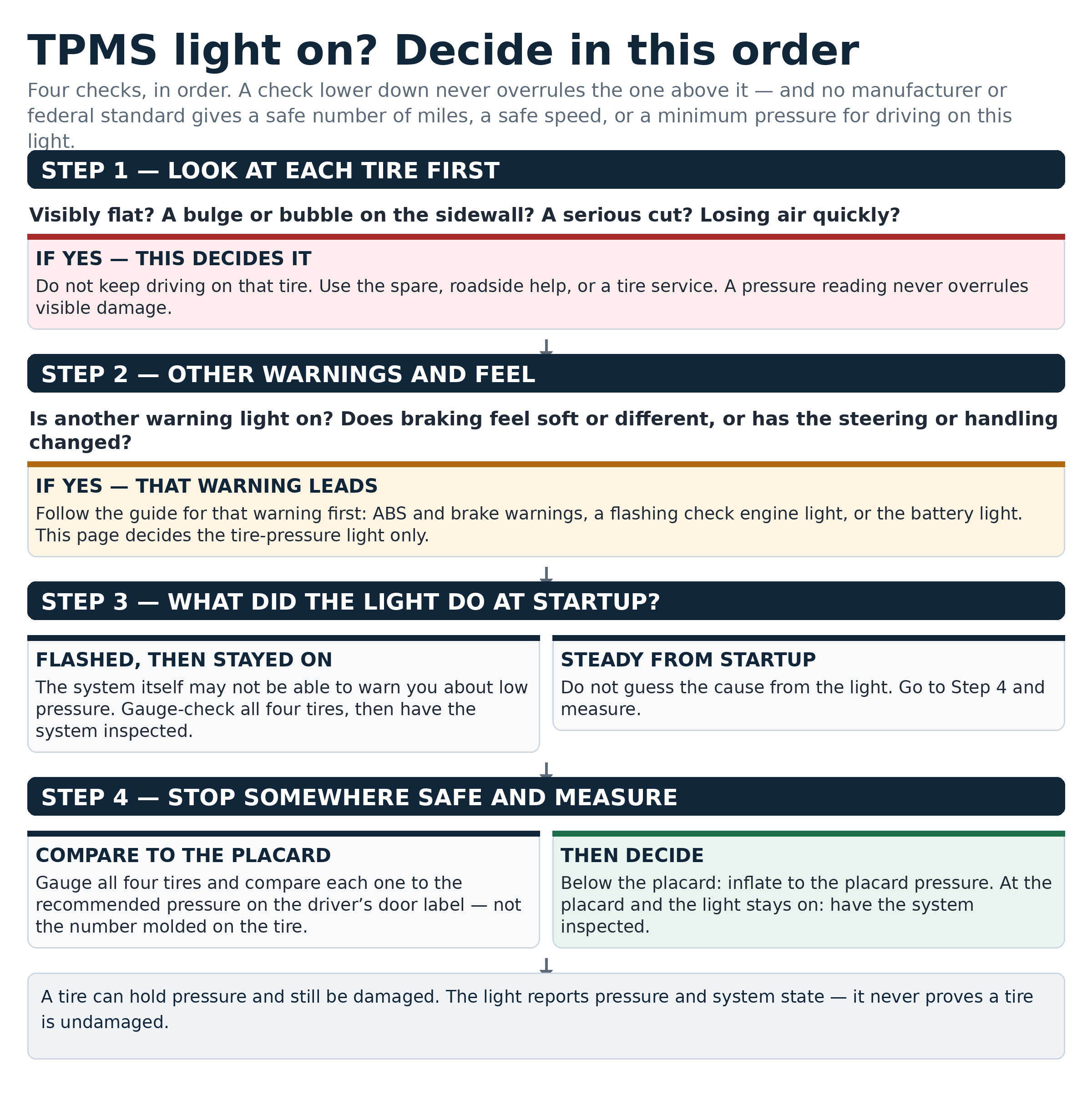
The short answer. No manufacturer and no federal standard gives a "safe" number for this light — not a number of miles, not a top speed, not a minimum PSI you can watch and keep driving. Any site that prints one invented it. What you should do depends on three things, checked in order: whether a tire is visibly damaged, what the light did when it appeared — steady from startup and flashed-then-stayed-on lead to different next steps below — and what a pressure gauge says against your own vehicle's recommended pressure. If a tire is visibly flat or damaged, that decides the situation before the light matters at all.
Work through the sections below in order. The first two can overrule everything after them.
Look at the tires first — visible damage ends the decision
Walk around the car and actually look at each tire before you think about the warning light. You are looking for:
- a tire that is visibly flat or sagging,
- a bulge or bubble on the sidewall,
- a serious cut or other obvious damage,
- a tire that is losing air quickly.
If you find any of these, do not continue normal driving on that tire. Michelin states that a bulge or bubble on the sidewall "always means replace the tire" because it indicates internal cord damage — "a structural failure, not a cosmetic issue" — and instructs: "Stop driving on that tire as soon as it's safe to do so, fit the spare, and bring the damaged tire in for inspection. Driving on a sidewall bulge risks a sudden blowout." Michelin also warns that it is not safe to reinflate a damaged tire, because the tire may rupture. NHTSA likewise tells drivers to stop using tires showing "signs of physical damage (cuts, cracks, bulges, etc.)."
The correct endpoint here is the spare, roadside assistance, or a tire service — not a gauge reading and not a careful drive on the damaged tire. A tire can read an acceptable pressure and still be structurally failed, which is why this section outranks every pressure check below.
Run-flat tires may have manufacturer-specific instructions; follow the tire and vehicle manufacturer's instructions for them.
If another warning is on, or the car feels wrong, that warning leads
This page decides the tire-pressure light only. If any of the following is also true, follow the linked guidance first — do not use this page to decide those warnings:
- The red BRAKE warning light is on, or the brake pedal feels soft, low, or different → see our ABS warning light guide and brake pedal guide.
- The check engine light is flashing → see our flashing check engine light guide.
- The battery warning light is on → see our battery light guide.
- The car has developed a new vibration, a persistent pull to one side, or noticeably heavier or changed steering along with the tire problem → treat it as a tire condition to have inspected rather than a light to drive on. NHTSA advises consulting a tire service professional when you notice tire performance issues such as noise or vibration, and Michelin notes that unusual vibration, pulling, or handling changes can indicate internal tire damage.
What did the light do when it appeared?
Your answer to this one question splits the page. There are two observable states:
A. The light was steady from startup. It came on and simply stayed on.
B. The light flashed for about a minute at startup, then stayed on.
These are not the same message. Under the federal tire-pressure monitoring standard (49 CFR 571.138), for systems whose malfunction indication shares the low-pressure telltale, a flash of 60 to 90 seconds at startup followed by steady illumination is the specified signal that the system has detected a malfunction in itself. Owner's manuals describe the same event in rounder language — the 2018 Ford F-150 manual says the telltale will "flash for approximately one minute and then remain continuously illuminated," and the 2023 Honda HR-V manual says the indicator "blinks for about one minute, and then stays on."
If your light flashed first (state B), the point of the warning is the system, not a confirmed pressure reading: in the wording federal rules require in owner's manuals, when the malfunction indicator is illuminated "the system may not be able to detect or signal low tire pressure as intended." That means the light, on or off, cannot vouch for your pressures. Your two actions are to verify the pressures manually with a gauge (below) and to have the system inspected — NHTSA's guidance for this state is to contact your vehicle dealer for a system inspection, and the 2023 Honda HR-V manual likewise directs the driver to have the tire inspected by a dealer as soon as possible. Do not treat a malfunction state as proof that your tires are fine.
If your light was steady from startup (state A), do not diagnose from the lamp's shape. A steady light does not automatically mean one specific cause. In the 2018 Ford F-150 manual, a steady light can accompany under-inflated tires, a spare tire in use, a system malfunction, or a tire rotation done without retraining the sensors. The 2023 Honda HR-V manual lists a steady indicator as "a tire pressure is significantly low, or the TPMS has not been calibrated." Different vehicles document different steady-state explanations. The action is the same in all of them: measure the actual pressures before deciding anything.
Stop somewhere safe, then measure
Federal rules require owner's manuals to carry this statement: "when the low tire pressure telltale illuminates, you should stop and check your tires as soon as possible, and inflate them to the proper pressure."
How to do that safely is ordinary caution rather than any regulation: stop in a safe place as soon as conditions allow before checking the tires. Do not stop in an active travel lane, and do not stand beside moving traffic to inspect or gauge a tire. (The 2023 Honda HR-V manual phrases the same step as: "Stop your vehicle in a safe place. Check the tire pressure and adjust the pressure to the specified level.")
Compare the gauge to your vehicle's placard — not to the tire
Use a pressure gauge on all four tires and compare each reading to the vehicle manufacturer's recommended pressure, which is printed on the tire information placard or label — typically on the driver's door jamb or the door edge. The 2018 Ford F-150 manual points to the Tire Label "located on the edge of driver's door or the B-Pillar," and the 2023 Honda HR-V manual to "a label on the driver side doorjamb."
Do not use the pressure molded into the tire's sidewall as your target. As NHTSA puts it, "the correct pressure for your tire is what the vehicle manufacturer has listed, NOT what is listed on the tire itself." There is no universal correct PSI that applies across vehicles, and this page will not print one.
For an accurate reading, measure when the tires are cold. NHTSA defines that as the car not having been driven for at least three hours. If you have been driving, NHTSA's guidance is to fill to the recommended cold inflation pressure shown on the placard and then recheck and adjust when you can get a cold reading — do not try to compensate for warm tires with a formula.
If a tire is below the placard pressure
Inflate the tire to the placard pressure. In the 2018 Ford F-150 manual, the instruction for an under-inflated tire is to "carefully drive the vehicle to the nearest location where air can be added" and inflate all tires to the recommended pressure. That is one manufacturer's instruction for a tire that is simply low and otherwise undamaged — it is not a general allowance, and the damage and warning gates above still govern. Treat the inflation as the fix for a simple low-pressure state, and pay attention to what happens next: a tire that is low again the next time you check, or that will not hold pressure, is not a warning-light question anymore — it needs a tire service to find out why.
Driving on a significantly under-inflated tire is the outcome the system exists to prevent: the federally required manual text warns that it "causes the tire to overheat and can lead to tire failure," and the 2023 Honda HR-V manual states the same point directly. This is also why "the tires look fine" settles nothing — NHTSA notes that under-inflated tires are visually difficult to detect, which is the entire reason for using a gauge.
How and when the warning clears varies by vehicle; follow the owner's manual.
If the pressures are correct and the light stays on
Correct pressure with a persistent warning moves the decision from the tire to the system. The 2018 Ford F-150 manual's instruction for this state is to contact an authorized dealer as soon as possible, and NHTSA's instruction for a system that is not operating properly is a dealer system inspection. Have the system inspected rather than assuming the light is mistaken — while a malfunction state exists, the system may not be able to warn you about a genuinely low tire. Do not assume a specific failed part from the driver's seat; that determination belongs to the inspection.
If the light appeared on a cold morning
Cold weather lowers actual tire pressure. A tire that was only marginally inflated can drop to the system's warning level overnight — which is why a cold night, early in the season or any other time, can be what finally turns the light on. That is a real pressure reading, not a false alarm: in a pressure-warning state, at least one tire is at or below the level at which the system is required to warn. The action is identical to every other steady-light state — measure against the placard and correct the pressure. Do not wait for warmer weather to make the decision for you, and do not inflate above the placard to pre-pay for the next cold night; the placard pressure is the target in every season.
If the spare tire is fitted
Warning behavior with a spare fitted varies by vehicle, and no single rule covers every car. The 2018 Ford F-150's system measures the pressure in its four road tires, and its indicator illuminates when the spare is in use. On the 2023 Honda HR-V, fitting the compact spare can turn the indicator on, or make it blink for about a minute and then stay on. Other vehicles may not monitor the spare at all. Check your owner's manual for what your vehicle does, and check the spare's pressure yourself with a gauge — NHTSA recommends checking the spare, along with the road tires, at least once a month.
What this light cannot tell you
- No light is not a safety certificate. The system reports pressure and system state. It does not inspect the tire. Cuts, cracks, bulges, and other structural damage are found by looking, which is why visible damage is the first section of this page rather than an afterthought.
- It does not replace manual checks. The federally required manual wording states: "the TPMS is not a substitute for proper tire maintenance, and it is the driver's responsibility to maintain correct tire pressure, even if under-inflation has not reached the level to trigger illumination." NHTSA recommends inspecting tires monthly with an accurate gauge.
- Systems do not all work the same way. Some systems estimate pressure from wheel-speed behavior instead of measuring it directly in the tire, and a system of that type can miss all four tires losing pressure evenly — one more reason the monthly manual check matters even when no warning is showing.
When service is the endpoint — recap
- Visible flat, bulge, serious damage, or rapid air loss → do not continue normal driving on that tire; spare, roadside assistance, or tire service.
- Flashed for about a minute, then stayed on → gauge-check the pressures, then system inspection.
- Pressures correct, warning persists → system inspection.
- A tire that keeps losing pressure → tire service to find the cause.
- Another warning light or changed braking/steering feel → the linked guide for that warning governs.
FAQ
Can I drive with the TPMS light on?
There is no approved distance, speed, or pressure floor for driving on this light — no manufacturer's manual or federal standard provides one. The decision runs through the gates on this page: visible damage stops the trip on that tire; otherwise, stop in a safe place, check the actual pressures against your vehicle's placard, and correct or escalate as the state requires. Treat any source that gives you a general number of miles for driving on this warning as inventing it.
What if the light flashes and then stays on?
That pattern — about a minute of flashing at startup, then steady — is the system's malfunction indication (60 to 90 seconds under the federal standard). It means the system may not be able to detect or signal low pressure as intended. Verify the pressures manually with a gauge, and have the system inspected.
The light is on, but the tires look fine. Is it safe to ignore?
No. Under-inflated tires are visually difficult to detect, and the warning is required to appear when a tire is significantly under-inflated — a tire can look normal and still be at the warning level. Only a gauge, compared with your vehicle's placard, can tell you whether the pressure is correct.
Can cold weather turn the TPMS light on?
Cold weather lowers actual tire pressure, and a marginally inflated tire can drop to the warning level on a cold night. The light is reporting a real pressure, not making a mistake. Measure and correct to the placard pressure.
Why is the light still on after I checked the pressure?
If the pressures are correct and the warning persists, have the TPMS inspected. The 2018 Ford F-150 manual explicitly directs the driver to authorized-dealer service in this condition, while NHTSA directs drivers to obtain a system inspection when TPMS is not operating properly. How and when the warning clears varies by vehicle; follow your owner's manual.
Should I use the PSI printed on the tire?
No. The number molded on the sidewall is not your target. Use the vehicle manufacturer's recommended pressure on the placard or label, usually on the driver's door jamb.
Does TPMS monitor the spare tire?
It varies by vehicle. Some systems do not monitor the spare, and on some vehicles fitting the spare turns the warning on. Check your owner's manual, and check the spare's pressure manually with a gauge.
Sources
Every procedure, quotation, and safety claim in this article traces to an official manufacturer or government source opened and re-verified during validation:
- 49 CFR 571.138 (FMVSS No. 138) — S4.2(a) low-pressure activation threshold, S4.4(c)(2) malfunction flash pattern, S4.5(a) owner-manual statements the standard requires. Read from the current eCFR text (version 2026-09-01). (https://www.ecfr.gov/api/versioner/v1/full/2026-09-01/title-49.xml?part=571§ion=571.138)
- NHTSA — Tires (TireWise) — Cold-pressure definition (not driven for at least three hours), placard vs. sidewall guidance, monthly checks including the spare, cold-morning behavior, malfunction endpoint, tire-damage stop criteria. nhtsa.gov (https://www.nhtsa.gov/vehicle-safety/tires)
- Michelin — Can My Tire Be Repaired? — Sidewall bulge as structural failure; "Stop driving on that tire as soon as it's safe to do so"; blowout risk. michelinman.com (https://www.michelinman.com/auto/auto-tips-and-advice/tire-maintenance/can-my-tire-be-repaired)
- Michelin — Flat Tire guidance — Not safe to reinflate a damaged tire; driving on a damaged tire risks rupture. michelinman.com (https://www.michelinman.com/auto/auto-tips-and-advice/tire-damage/flat-tire)
- 2018 Ford F-150 Owner's Manual (Second Printing, Oct 2017, JL3J 19A321 AB) — Malfunction flash wording ("approximately one minute"), Tire Label location, steady-light documented explanations, spare-in-use behavior, correct-pressure/persistent-light dealer instruction. Ford statements in this article are scoped to this manual. fordservicecontent.com (http://www.fordservicecontent.com/Ford_Content/Catalog/owner_information/2018-Ford-F-150-Owners-Manual-version-2_om-EN-US_10_2017.pdf)
- 2023 Honda HR-V Owner's Manual — "Stop your vehicle in a safe place," steady-indicator meanings, blink-then-on dealer endpoint, doorjamb pressure label, compact-spare indicator behavior. Honda statements in this article are scoped to this manual. techinfo.honda.com (https://techinfo.honda.com/rjanisis/pubs/om/ah/a3v02323iom/enu/details/131237047-15984.html)