Windshield Wipers Not Working: Decide by What You Can See
Your windshield wipers have stopped, and right now the cause is not the important part. The only fact that decides your next move is what you can see through the glass. This page makes that decision with you first, then reads the failure pattern for what it changes about urgency and what you should report. It contains no repair steps, no fuse or motor procedures, and no number for how far or how fast anyone can drive on a failed wiper system. Where a reassuring number cannot be supported, this page says so instead of inventing one.
The short answer
- If the wipers' remaining function does not keep the glass clear enough for a clear view, do not continue the trip. Move out of traffic when you can do so safely, and make the next decisions — waiting out the weather, arranging help — from a stopped, safe place. That is this page's safety judgment, and we label it as ours: it rests on the visibility in front of you, not on an official rule. No NHTSA or manufacturer procedure tells drivers what to do when wipers fail mid-drive; we looked for one and did not find it, and nothing here will pretend to quote one.
- If a working speed is genuinely keeping your view clear, you still have a failed wiper system, not a reprieve. Rain gets heavier. Other vehicles throw spray. Darkness shrinks what a marginal sweep can do. The conservative course is to end the trip at the first safe opportunity instead of spending the remaining function, and to treat the repair as due before the next wet drive.
- The failure pattern never grants driving permission by itself. It changes how urgent the inspection is and what you report. The view decides whether you move; the pattern decides what happens after you stop.
Everything below is the reasoning and the boundaries behind that verdict.
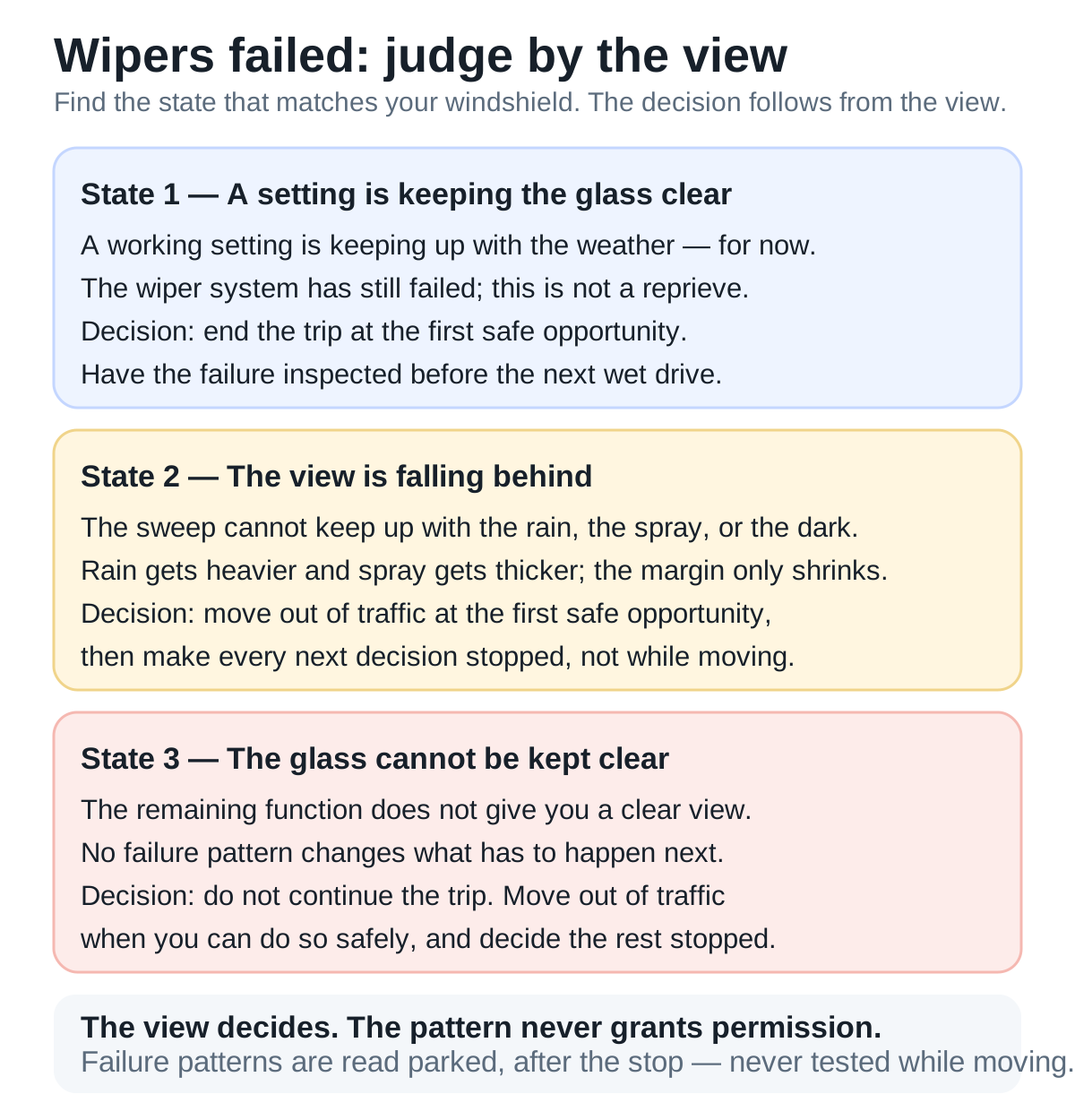
Decide by the view, not by the pattern
The same failure can have opposite correct decisions in two cars. One working speed may keep up with drizzle on a bright afternoon and be useless in a downpour, in highway spray, or at night. A blade that stops across the middle of its sweep can take away more view than a system that fails with the blades resting at the bottom of the glass. So the pattern questions on this page are parked questions: if the view is compromised, getting out of traffic comes first, and the pattern is read afterward, standing still.
If the wipers stop while you are driving
- Judge the view, not the controls. If you cannot maintain a clear view, the only task is to move out of traffic when you can do so safely. Nothing else in this article matters until you are stopped somewhere safe.
- Do not turn the wiper switch into a test while you are moving. Using the control the way you normally would is part of driving. Cycling through the settings to see which ones respond, watching the blades, or listening for the motor while the view is poor splits your attention at exactly the wrong moment. Every check on this page happens parked.
- Do not get out of the car in or beside live traffic to clear the glass. Clearing snow or an obstruction is a stopped-car task, done where you are not standing next to moving vehicles.
- If you can still see clearly, stop at the first safe place anyway. The failure has already happened; the remaining function holds only while conditions hold. Ending the trip is not overreacting — it is refusing to bet your view on the weather.
After you stop somewhere safe: read the pattern
Parked, in a safe place, note which of these matches what happened. Each pattern narrows what an inspection checks first and belongs in the report you give the shop. None of them names the failed part.
- Dead on every setting, and silent. No sweep, no motor sound. That is consistent with several different failures — the power supply, the control, and the motor are all still in play — and the observation cannot separate them. Anyone who tells you a silent system "means the motor" is guessing.
- You can hear the motor, but the blades do not move. The motor is running and the motion is not reaching the blades. That points the inspection at whatever carries the motion between them — it does not name which piece in that chain has failed.
- One setting works; the others do not. This includes intermittent or automatic modes failing while a manual speed still sweeps. What matters is what the working setting does to your view in the weather you actually have; a setting that cannot keep up with the rain is not a working view. Note exactly which settings respond.
- The blades stop mid-sweep, or will not park at the bottom. Record where they come to rest. A blade stopped across the glass takes view away by itself, so rest position is part of the visibility picture, not a footnote.
- They move, but slowly, weakly, or unevenly. Movement is not the same as clearing. The test is the one at the top of this page: the view they actually give you.
- They stopped under snow, ice, or an obstruction. One documented example, with its limits: Honda's owner manuals instruct that if the wipers stop because of an obstacle such as snow buildup, you park in a safe place, switch the wipers off, turn the power off, and only then remove the obstacle. Honda also warns against operating wipers frozen to the glass. That is Honda's instruction for Honda vehicles; your owner's manual is the authority for yours.
- They came back on their own after a few minutes. Honda's manuals also note that a wiper motor can stop temporarily under an overload and resume within a few minutes. Read that narrowly: one manufacturer's documented behavior, in its manuals. A system that restarts itself has not repaired itself — it has shown you a pattern, and the pattern's instruction is an inspection. It is never a reason to sit in a live lane waiting for a restart.
What the pattern does — and what it does not prove
A characteristic pattern is not a confirmed diagnosis, and this page will not upgrade one into the other.
- Dead-and-silent does not prove a motor. Motor sound without blade movement does not prove a specific part between the motor and the blades. One working setting does not prove a switch.
- Buy or replace nothing on the strength of a pattern you observed from the driver's seat.
- What the pattern is genuinely for is the report: which settings responded, what you heard, where the blades stopped, what the weather and load were, and what else failed at the same moment. That report is useful evidence. A guessed part is not.
Why the law treats wipers as required equipment — state by state
The law appears on this page for one reason: it settles whether a dead wiper system can wait until it rains again. The duties below are equipment duties — the condition the car must be kept in — and they are written state by state. They are not fine schedules, and listed together they do not become a national rule.
- Florida (Stat. §316.2952) requires every windshield wiper on a motor vehicle to be "maintained in good working order."
- Texas (Transp. Code §547.603) requires the windshield-cleaning device to be "maintained in good working condition."
- California (Veh. Code §§26706–26707) goes further: wipers must be maintained in good operating condition, must provide clear vision, and must be operated under conditions of fog, snow, or rain.
- New York (VAT §375(1)(b)) sets the clear-vision standard: wipers that clear a sufficient area of the windshield "to provide reasonable driving vision." New York's wording is an equipment standard — it is included for the vision test it states, not as a maintenance rule.
- At the federal level, wipers are required safety equipment on new vehicles; FMVSS No. 104 sets the clearing performance manufacturers must build to. That is a rule for manufacturers, not a procedure for drivers, and this page uses it only as background.
Read together, these duties support treating a failed wiper system as due for repair before the next wet drive — but the decision to stop in the rain itself remains the visibility judgment at the top of this page, not a legal quotation.
When this is not your page
The neighboring problems are covered on their own pages. If your main situation matches one of these, you are in the wrong article:
- The wipers died together with a battery warning light, dimming lights, or several electrical systems failing at once → Battery Light On While Driving. That is a car losing electrical power while driving — a different decision, owned by that page. This page routes there and does not expand into charging-system diagnosis.
- The car also will not crank or start → Car Won't Start. A no-start is that page's problem, not a wiper pattern.
- The wipers will not switch off → not this page. Your visibility is not the thing being lost, the decision is different, and this framework does not apply.
- Only the rear wiper has failed → not covered here. It plays a different visibility role and is a different driver's task.
- The washer fluid will not spray → not covered. That is the washer system, not wiper motion.
- Streaking, chattering, skipping, or visibly worn blades → not covered. That is blade condition and maintenance, not a failure to decide about.
What this page will not tell you
- No safe speed, distance, or time for driving with failed wipers. No source we can stand behind publishes one, so neither do we.
- No repair procedures. No motor, switch, linkage, or wiring work — and no fuse steps either; the fuse gets its full answer in the last FAQ below. That absence is deliberate: this is a decision page, not a repair manual.
- No costs. Not a range, not a "usually runs about." Your inspection produces the estimate.
- No probabilities. We will not tell you a dead wiper system is "usually just a fuse" or "almost always the motor." Those sentences fill repair pages; they are not evidence about your car.
- No official protocol. The stop decision above is a visibility judgment, labeled as this page's judgment. If a regulator or manufacturer ever publishes a real wiper-failure procedure, this page will cite it instead of implying one.
- No diagnosis from a pattern alone. Only a hands-on inspection confirms what failed.
Your job as the driver is the short version: judge the view, make no test decisions while you are moving, read the pattern parked, and let the inspection name the part.
This page makes the visibility decision and reads the pattern. Only a hands-on inspection confirms what failed on your vehicle.
FAQ
My wipers stopped in heavy rain. Should I pull over?
If the remaining function does not keep your view clear, yes. What kind of instruction is that? This page's visibility judgment — not an official rule, for the reason given in the short answer above. Do not spend the moment cycling settings or watching the blades; stopping comes first, and the pattern is read afterward, parked.
One speed still works. Can I finish my trip?
Only the view can answer that, and the view is decided by the weather you are actually in — rain intensity, spray from other vehicles, darkness. A working setting that keeps the glass genuinely clear in light rain can fall behind in a downpour. This page grants no blanket permission: the system has failed, conditions can worsen, and the conservative course is to end the trip at the first safe opportunity and have the failure inspected before the next wet drive.
Is it illegal to drive with wipers that do not work?
There is no single national answer this page can honestly give you. States write the duty as equipment law: Florida and Texas require wipers to be maintained in good working order or condition, California requires maintained wipers that provide clear vision and are operated in fog, snow, or rain, and New York requires wipers that clear enough windshield to provide reasonable driving vision. Those are state equipment duties, not a universal driving ban, and this page states no fine. The driving decision in rain is the visibility judgment above.
The wipers started working again after a few minutes. Is it fixed?
No — a restart is not a repair. One documented version of this: Honda's owner manuals note that a wiper motor can stop under an overload and resume within a few minutes; that behavior is Honda's, and your manual is the authority for your vehicle. Whatever produced your restart, a system that has stopped once has shown an intermittent pattern — it can stop again, at a worse moment. The pattern's instruction is an inspection, not reliance.
Can't I just check the fuse and get going again?
This page contains no fuse locations, amperages, or replacement steps, by design — that is repair work, and this article does not teach it at the roadside. Two decisions come first anyway: the visibility decision while you are moving, and a safe stop. After that, the pattern you observed is what an inspection starts from; if a fuse is part of that inspection, it is checked as inspection work, not as a driver's roadside test.
Sources
Every statute, manufacturer instruction, and federal standard cited in this article traces to the official source below. The visibility decision itself is this page's own editorial judgment — labeled as such on-page — and is not attributed to any of these sources:
- Fla. Stat. §316.2952(3)–(4) — Windshield wipers — Florida equipment duty only: every windshield wiper on a motor vehicle must be "maintained in good working order." No driving ban and no fine is stated on this page. flsenate.gov (https://www.flsenate.gov/Laws/Statutes/2011/0316.2952)
- Tex. Transp. Code §547.603 — Windshield cleaning device — Texas equipment duty only, codified text: the windshield-cleaning device must be "maintained in good working condition." statutes.capitol.texas.gov (https://statutes.capitol.texas.gov/docs/TN/htm/TN.547.htm)
- Cal. Veh. Code §§26706–26707 — Windshield wipers — California only: wipers maintained in good operating condition, must provide clear vision, and must be operated under conditions of fog, snow, or rain (§26707). Never generalized to U.S. law. leginfo.legislature.ca.gov (https://leginfo.legislature.ca.gov/faces/codes_displaySection.xhtml?lawCode=VEH§ionNum=26707)
- N.Y. VAT §375(1)(b) — Windshield wipers — New York clear-vision equipment standard: wipers that clear a sufficient area of the windshield "to provide reasonable driving vision." Not written on this page as a maintenance rule. nysenate.gov (https://www.nysenate.gov/legislation/laws/VAT/375)
- 49 CFR 571.104 (FMVSS No. 104) — Windshield wiping and washing systems — Manufacturer new-vehicle clearing-performance standard; cited as background only and never as a driver rule. Read from the current eCFR text (version 2026-09-01). ecfr.gov (https://www.ecfr.gov/api/versioner/v1/full/2026-09-01/title-49.xml?part=571§ion=571.104)
- Honda Owner's Manual (2022 CR-V Hybrid) — Windshield Wipers — Honda-scoped only: if the wipers stop because of an obstacle such as snow buildup — park in a safe place, switch the wipers off, turn the power off, and only then remove the obstacle; do not operate wipers frozen to the glass; a wiper motor can stop temporarily under an overload and resume within a few minutes. This manual is the authority only for its vehicles. owners.honda.com (https://owners.honda.com/utility/download?path=/static/pdfs/2022/CR-V/2022_CR-V_FHEV_Windshield_Wipers.PDF)